


News
Why Seal Aging Causes Internal Leakage in Case CX210B/CX240B Travel Motors

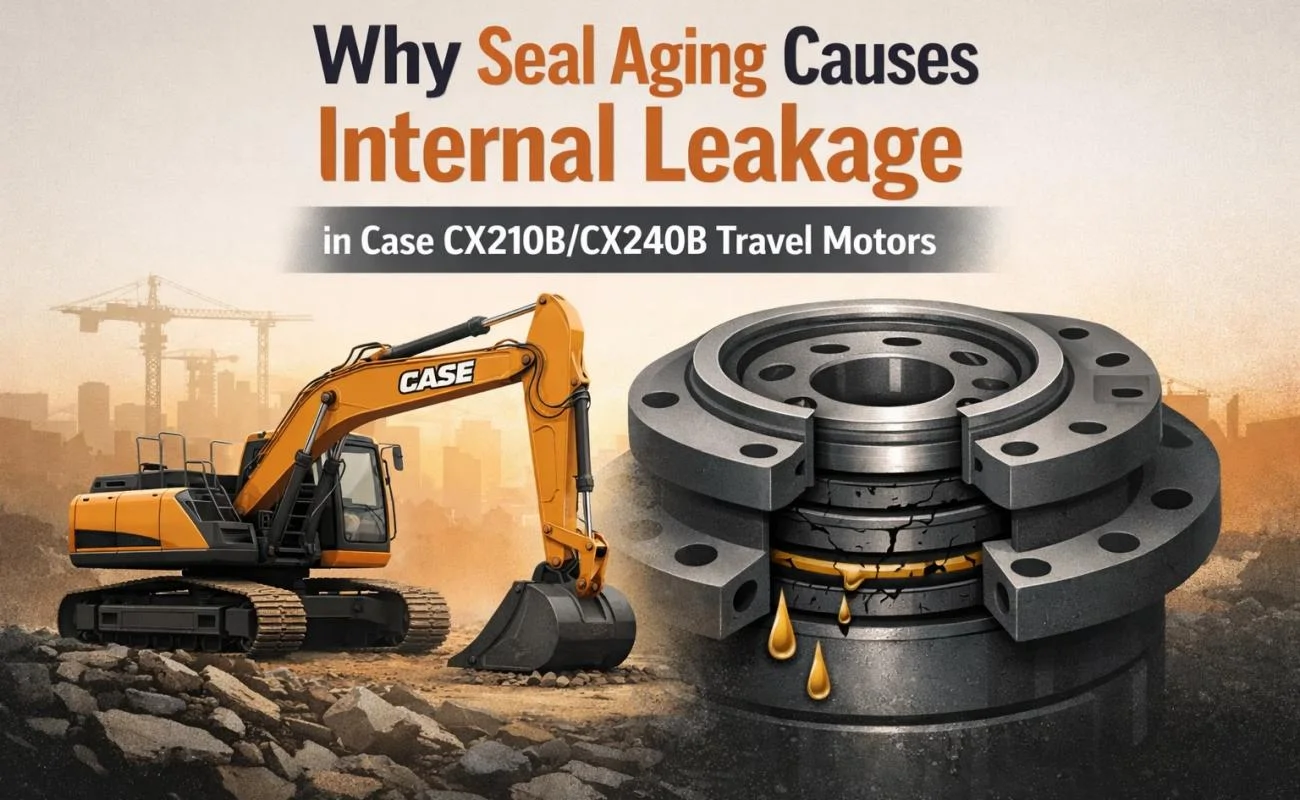
In the 20-ton excavator segment, the Case CX210B and CX240B have long been reliable workhorses for contractors worldwide. With mature structural design and stable hydraulic systems, these models have served across construction, mining, and infrastructure projects for more than a decade.
However, once machines exceed 8–12 years of service life, common issues begin to appear:
- Travel weakness
- One-side drifting
- Reduced travel speed after warm-up
- Abnormally high travel motor housing temperature
Many operators initially suspect hydraulic pump deterioration or main control valve wear. Yet in a large number of field repair cases, the root cause is often more fundamental — internal leakage inside the hydraulic travel motor caused by aging seals.
1. Why Travel Deviation Occurs in Aging CX210B / CX240B Machines
1.1 Closed-Loop Travel System Characteristics
The CX210B and CX240B utilize a closed-loop travel circuit. The hydraulic pump delivers high-pressure oil directly to the travel motor, and displacement control regulates speed and torque output.
Under normal pressure conditions, left and right travel should remain synchronized.
However, in high-hour machines, internal sealing components gradually lose performance, disrupting pressure balance inside the motor.
1.2 Internal Leakage: The Core Technical Cause
The most critical factor behind travel weakness is increased internal leakage.
When internal components such as:
- Piston seals
- Valve plate sealing rings
- Shaft seals
begin to age, high-pressure oil can no longer be fully converted into effective torque. Instead, part of the oil bypasses through internal clearances and returns to the motor housing.
This results in:
- Reduced volumetric efficiency
- Lower effective torque output
- Increased housing return flow
- Elevated operating temperature
Even if the hydraulic pump remains in acceptable condition, degraded motor seals alone can significantly reduce travel performance.
2. Technical Aging Patterns of Hydraulic Seals
Hydraulic travel motor seals are typically made of NBR, polyurethane, or composite elastomer materials. Under prolonged high-pressure and high-temperature cycles, three common degradation mechanisms occur:
2.1 Thermal Oxidation Aging
Continuous operation at oil temperatures between 80–100°C causes molecular chain breakdown in elastomers. Over time, seals lose elasticity and preload force, reducing sealing effectiveness.
2.2 Compression Set Deformation
Long-term exposure to high pressure causes permanent deformation. Seals fail to recover their original shape, creating micro leakage channels.
2.3 Contamination-Induced Lip Wear
Metal particles in contaminated oil accelerate abrasion on seal lips. Once the sealing edge loses contact integrity, internal bypass leakage increases rapidly.
For machines exceeding 10,000 operating hours, seal fatigue alone can degrade travel motor efficiency — even when core metal components such as pistons and cylinder blocks remain within tolerance.
3. Why Seal Repair Should Be Prioritized Over Motor Replacement
Complete travel motor replacement is costly. Meanwhile, ignoring internal leakage forces the hydraulic pump to compensate by increasing displacement, which:
- Raises system temperature
- Increases overall load
- Accelerates pump wear
- Creates a vicious cycle of thermal stress
Replacing the hydraulic seal kit can restore volumetric efficiency without replacing major structural components.
As long as pistons, cylinder block, and valve plate wear remain within acceptable limits, seal refurbishment often restores performance close to factory condition.
This approach is especially critical in the used-equipment refurbishment market, where accurate diagnosis prevents unnecessary overhauls and reduces total repair cost.
4. KINTON High-Precision Hydraulic Seal Repair Solution
For aging Case travel motors, KINTON SEALS provides precision-controlled hydraulic seal repair kits designed to address internal leakage at its source.
Key technical improvements include:
- High-temperature resistant NBR composite materials
- Strict cross-section tolerance control to ensure proper preload
- Reinforced sealing lip structure for contamination resistance
- Complete seal combinations to prevent mismatch during partial replacement
When combined with proper clearance inspection and assembly procedures, seal replacement can:
- Reduce housing return oil flow
- Improve hot-condition travel power
- Minimize left-right deviation
- Extend motor service life
Conclusion
For long-serving Case CX210B and CX240B excavators, travel weakness does not necessarily indicate hydraulic pump failure or complete motor breakdown.
In many cases, the true cause lies in natural aging of the internal seal system, leading to increased internal leakage and torque loss.
A rational diagnostic approach — starting with pressure testing and housing return flow measurement — allows accurate identification of internal motor leakage.
By upgrading to high-quality hydraulic seal repair kits, operators can control maintenance cost while extending machine service life.
For motor model confirmation or seal specification matching, provide your motor serial number or seal part number for technical support.