
News
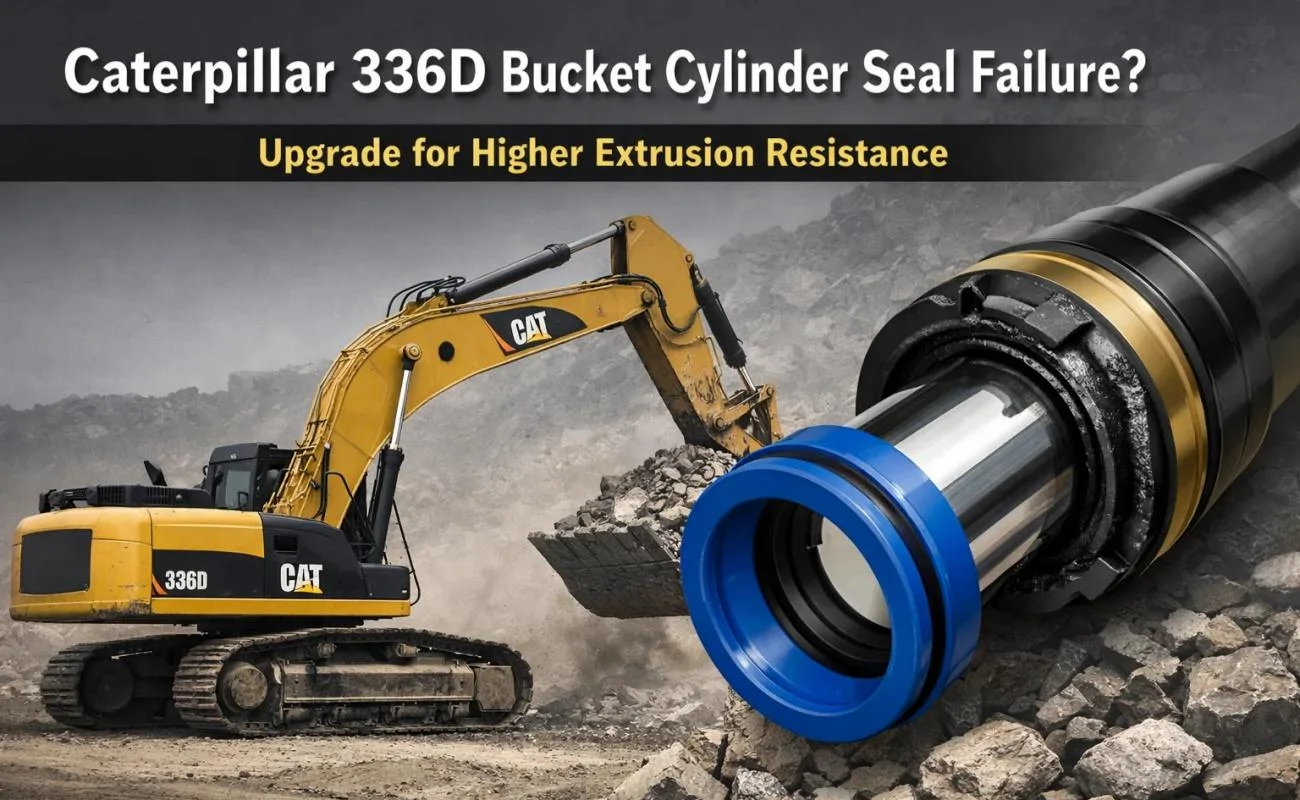
Caterpillar 336D Bucket Cylinder Seal Failure? Upgrade for Higher Extrusion Resistance

In mining and heavy-duty rock-breaking applications, the Caterpillar 336D is widely recognized as a high-force platform. Its large-tonnage structure and powerful hydraulic system enable stable performance under extreme load conditions.
However, precisely because of these high-impact working environments, the bucket cylinder becomes one of the most highly stressed components in the entire hydraulic system.
Compared with the boom and arm cylinders, the bucket cylinder experiences:
- More frequent pressure spikes
- Stronger reverse impact loads
- Higher cyclic stress intensity
Over time, these repeated high-pressure shock loads place significant demands on the piston seal system — particularly its extrusion resistance and fatigue durability.
1. The Pressure Spike Challenge in Mining Conditions
1.1 Instantaneous High-Pressure Peaks
In standard earthmoving operations, hydraulic pressure changes are relatively stable and gradual.
In contrast, during mining, rock prying, and heavy ripping operations, the hydraulic circuit frequently experiences rapid pressure surges.
When the bucket strikes hard rock or performs prying actions:
- System pressure may rapidly approach relief valve settings
- Pressure rise time is extremely short
- Shock loads are concentrated
This creates a critical sealing challenge.
1.2 Why Piston Seals Fail Under Shock Load
High-pressure pulses act directly on the clearance between the piston and cylinder bore.
If assembly clearance exists — even within tolerance — extreme pressure can force elastomeric sealing materials (rubber or polyurethane) into the extrusion gap. This phenomenon is known as seal root extrusion.
Consequences include:
- Edge nibbling and deformation
- Material tearing
- Increased internal leakage
- Reduced bucket holding capacity
- Sluggish or weakened bucket response
Seal damage in this context is not a structural flaw of the cylinder — it is a performance limit issue under extreme impact cycles.
2. Limitations of Standard OEM Seals in Heavy Mining Use
OEM piston seals are typically designed based on standard pressure ranges and average duty cycles.
In continuous high-impact mining operations, single-material standard seals may approach their extrusion resistance limit.
Common failure symptoms include:
- Burrs or partial edge damage on piston seals
- Metallic debris inside the cylinder
- Slower hydraulic response at high temperature
- Gradual decline in bucket holding force
These are not necessarily cylinder failures — they are indicators that the sealing system is operating beyond its intended safety margin.
3. Technical Path to Improve Extrusion Resistance
Upgrading extrusion resistance is not simply about increasing material hardness.
A proper anti-extrusion design focuses on structural reinforcement.
Two key technical approaches are commonly used:
3.1 Optimized Seal Geometry and Preload
Careful control of seal cross-section and compression ratio ensures stable surface contact under high pressure without excessive deformation.
3.2 Reinforced Back-Up Rings
High-strength back-up rings made from:
- Nylon (PA)
- Polyoxymethylene (POM)
provide rigid support behind the primary seal.
These materials offer:
- High compressive strength
- Low deformation rate
- Excellent wear resistance
By combining elastic sealing elements with rigid support rings, composite seal systems prevent extrusion into piston-to-bore clearance gaps while maintaining sealing conformity.
4. KINTON SEALS Composite Piston Seal System for 336D
For long-term heavy-duty applications such as Caterpillar 336D mining operations, KINTON SEALS provides reinforced composite piston seal systems designed specifically for high-impact environments.
The goal is not simply to increase hardness, but to improve overall structural stability and safety margin.
Technical Features:
- High-pressure resistant polyurethane primary seals
- Single or dual reinforced back-up rings (PA or POM)
- Strict dimensional tolerance control
- Optimized oil groove structure for stable lubrication film formation
Under sustained mining shock loads, this composite design:
- Significantly reduces edge damage probability
- Minimizes internal leakage
- Maintains bucket holding performance
- Extends major overhaul intervals
5. From “Functional” to “Impact-Resistant”: A Preventive Upgrade Strategy
For heavy-duty equipment, hydraulic reliability should not be defined merely as “working normally.”
High-frequency, high-impact components like bucket cylinders require sufficient shock tolerance margin.
Instead of waiting for leakage to occur and repeating repairs, upgrading to a higher extrusion-resistance seal configuration at an early stage is often the more rational cost-control approach.
For long-term mining operations, this proactive strategy reduces downtime risk and improves lifecycle stability.
Conclusion
In extreme mining environments, piston seal extrusion is one of the primary causes of bucket cylinder performance degradation in Caterpillar 336D machines.
By upgrading to reinforced composite piston seals with back-up ring support, operators can significantly enhance extrusion resistance, reduce internal leakage, and extend service intervals.
For cylinder bore size confirmation or pressure-grade matching recommendations, provide your machine model and operating environment details. KINTON SEALS can recommend suitable composite sealing solutions based on working pressure and clearance parameters.