


News
Track Tension Failure in Excavators: How Track Adjuster Seals Affect Undercarriage Performance

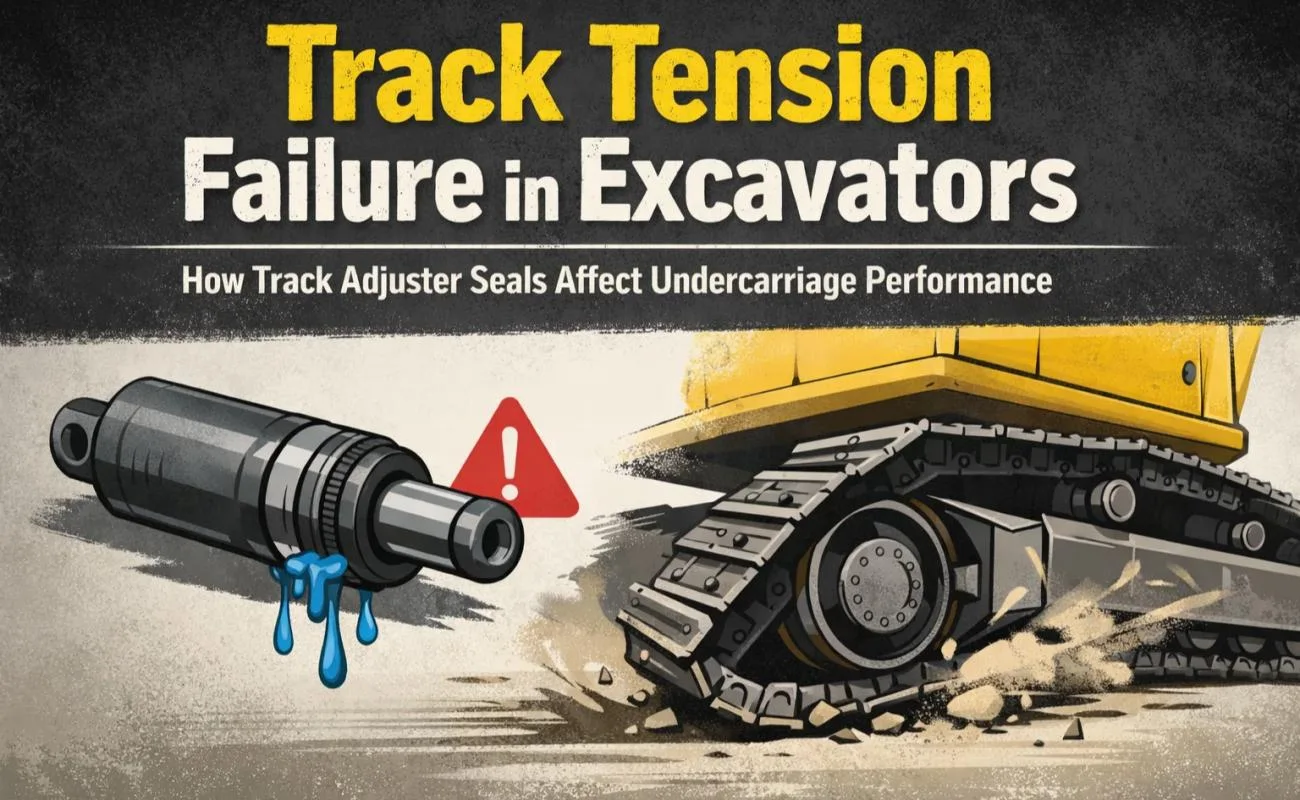
In daily undercarriage maintenance, operators often focus on visible components such as track chains, rollers, or sprockets. However, one critical component is frequently overlooked—the track adjuster assembly, commonly known as the grease cylinder.
This system uses high-pressure grease to push a piston forward, moving the idler and maintaining proper track tension. When functioning correctly, it ensures stable track operation during travel and turning.
However, once the track adjuster seal begins to fail, grease pressure gradually drops. As a result, track tension decreases, and in severe cases, the track may even derail.
In many real-world cases, what appears to be a sudden “track derailment” is actually the result of long-term seal failure inside the adjuster system.
How the Track Adjuster Maintains Tension
Grease Pressure Drives the System
The working principle of the track adjuster is relatively straightforward.
By injecting high-viscosity grease into the cylinder:
- The piston is pushed outward under pressure
- The front idler moves forward
- The track chain is tightened
At the same time, an internal spring or recoil mechanism absorbs shock loads generated during operation, helping maintain stable tension.
The Role of Seals
Within this system, seals perform two essential functions:
- Contain high-pressure grease inside the cylinder
- Prevent external contaminants such as mud and sand from entering
If sealing performance declines, the system can no longer maintain stable internal pressure.
Why Seal Failure Leads to Track Loosening
High-Pressure Grease Challenges Sealing
Unlike standard hydraulic systems, track adjusters use high-viscosity grease instead of hydraulic oil. Under pressure, grease continuously applies force against the sealing surfaces.
If seal material degrades or lacks sufficient strength:
- Grease begins to slowly leak through sealing gaps
- Internal pressure gradually drops
Loss of Tension and Increased Risk
As pressure decreases:
- The idler retracts
- Track tension reduces
- The track becomes unstable
When operating on uneven terrain, turning, or climbing over rocks, a loose track is far more likely to slip off the idler or rollers, causing derailment.
Although the failure may seem sudden, it is typically the result of progressive sealing failure over time.
Harsh Undercarriage Conditions Accelerate Seal Wear
Constant Exposure to Contamination
Track adjusters operate in one of the harshest parts of the machine. Mud, sand, and debris continuously impact the cylinder housing.
If sealing performance is insufficient:
- Contaminants can enter the cylinder
- Internal components may wear faster
- Piston movement may become restricted
Impact in Mining and Muddy Environments
In environments such as:
- Mining sites
- Quarries
- Muddy construction areas
fine abrasive particles can easily penetrate weak sealing systems. This significantly accelerates seal wear and reduces system reliability.
Key Design Requirements for Grease Seals
Pressure Resistance and Anti-Extrusion
Grease seals for track adjusters must handle:
- High internal pressure
- Continuous extrusion force on sealing lips
This requires strong material properties and stable structural design.
Contamination Resistance
In addition to pressure resistance, seals must:
- Block mud and water intrusion
- Maintain sealing integrity under vibration and shock
KINTON SEALS Solution
KINTON SEALS provides track adjuster sealing solutions specifically designed for high-pressure grease environments.
Key features include:
- High-strength sealing materials
- Optimized lip structure for anti-extrusion performance
- Stable sealing under pressure and vibration
- Effective protection against contamination
With reliable sealing, the adjuster system can maintain consistent pressure, ensuring proper track tension over extended operating periods.
Small Component, Critical Impact
Although the track adjuster cylinder is relatively small, its role in the undercarriage system is critical.
When tension cannot be maintained:
- Track derailment risk increases
- Wear on chains, idlers, and rollers accelerates
- Overall undercarriage efficiency decreases
For this reason, regular inspection is essential.
Operators should periodically check:
- Grease leakage around the adjuster
- Changes in track tension
- Abnormal track looseness
Early detection and seal replacement can prevent far more complex and costly repairs.
Conclusion: Prevent Failure Before It Happens
Track tension issues rarely occur suddenly. In most cases, they develop gradually due to seal wear and pressure loss.
Replacing a track adjuster seal kit is a simple and cost-effective maintenance step that can prevent:
- Track derailment
- Undercarriage damage
- Expensive downtime
KINTON SEALS supplies a wide range of track adjuster seals for excavators and bulldozers.
If your equipment shows signs of track loosening, pressure loss, or grease leakage, feel free to provide the seal part number or machine model for matching solutions.
Frequently Asked Questions
What causes excavator track tension loss?
Track tension loss is usually caused by grease leakage from the track adjuster cylinder, often due to worn or damaged seals.
How do I know if my track adjuster seal is failing?
Common signs include:
- Grease leakage near the adjuster
- Gradually loosening track
- Reduced tension stability
Can a loose track cause damage?
Yes. Loose tracks can:
- Derail during operation
- Increase wear on rollers and idlers
- Reduce machine stability
How often should track adjuster seals be checked?
They should be inspected during regular undercarriage maintenance, especially in harsh environments like mining or muddy conditions.