


News
Warning Signs of Dual-Cone Seal Failure in Excavator Undercarriage

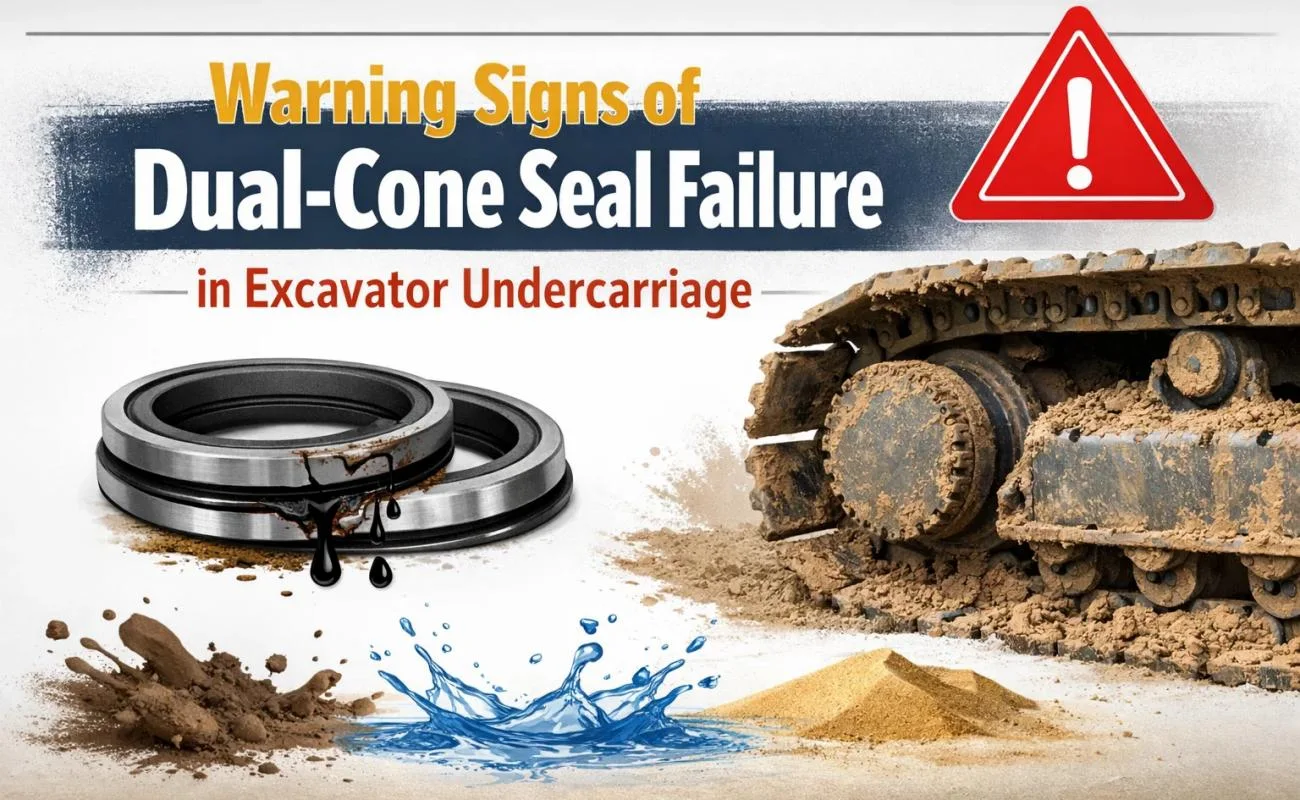
In crawler construction equipment, the undercarriage system operates in some of the harshest working environments imaginable. Components such as track rollers, carrier rollers, and travel gearboxes are constantly exposed to mud, sand, water, and heavy shock loads.
To protect internal lubrication systems from contamination, these components commonly use a special sealing structure known as Dual-Cone Seals, often referred to in the industry as floating seals or Duo-Cone seals.
Compared with conventional oil seals, this design is far better suited for extreme working conditions. As a result, it is widely used in the undercarriage systems of excavators, bulldozers, and mining equipment.
However, in real-world operations, floating seal failure rarely causes immediate mechanical breakdown. In many cases, the problem goes unnoticed until internal lubricant has already leaked out and the bearing lubrication condition has deteriorated significantly. Only then do operators discover overheating rollers or even complete roller seizure.
In reality, Dual-Cone seals usually provide several early warning signs before total failure occurs. Recognizing these signals early can often prevent major damage. Replacing a seal set costing only tens of dollars may avoid the replacement of an entire roller assembly costing hundreds.
Why Rubber Seals Age During Storage
Face Pressure Creates the Seal
A typical Dual-Cone seal system consists of:
- Two precision-machined alloy cast iron sealing rings
- Two rubber O-rings that provide elastic preload
After installation, the rubber rings generate axial pressure, forcing the metal sealing faces into constant contact. During operation, this contact creates a reliable sealing interface between the rotating and stationary components.
Under ideal conditions, a very thin oil film forms between the metal faces. This film performs two important functions:
- Reduces friction during rotation
- Prevents external contaminants such as mud or sand from entering the internal cavity
At the same time, the rubber O-rings maintain continuous pressure on the metal rings, ensuring the sealing faces remain properly aligned even under vibration and heavy shock loads.
Once the face pressure decreases, the rubber rings age, or abrasive particles enter the sealing interface, the sealing performance will gradually deteriorate.
Three Early Warning Signs of Dual-Cone Seal Failure
1. Oil-Mud Mixture Appearing Around the Roller Housing
One of the earliest signs of floating seal failure is not an obvious oil leak, but rather a ring of oily mud forming around the outside of the track roller or carrier roller housing.
This happens because internal lubricating oil begins to slowly seep out of the sealing interface and mixes with dust, dirt, and sand from the working environment.
Many operators mistakenly assume this is simply normal contamination from construction sites. In reality, it often indicates that the seal faces have begun to wear or the contact pressure has decreased.
As the machine continues to operate, the contaminated area gradually expands and eventually develops into visible oil leakage.
If the seal is replaced at this stage, internal bearing lubrication can usually still be preserved.
2. Abnormally High Roller Temperature
When the Dual-Cone seal loses its sealing capability, internal lubricant begins to escape. As the oil level decreases, the bearing inside the roller may start operating under semi-dry friction conditions.
This leads to a noticeable increase in operating temperature.
Under normal conditions, the outer temperature of a roller housing is typically similar to that of surrounding undercarriage components. It should not show significant localized overheating.
If one roller becomes significantly hotter than the others after machine operation, it is often a sign that internal lubrication conditions have already changed.
If operation continues without repair, the bearing raceways and rollers may begin to wear due to insufficient lubrication, eventually leading to roller seizure or complete failure.
3. Visible Wear Marks on the Metal Seal Faces
During equipment overhaul or undercarriage component replacement, inspection of the floating seal faces can reveal important information.
If the metal sealing surfaces show clear circular wear marks, scratches, or localized burn marks, it usually indicates that the lubricating oil film between the faces has been lost.
Several factors can cause this condition, including:
- Aging O-rings that reduce sealing pressure
- Contaminants entering the sealing interface
- Abrasive wear caused by sand or mineral particles
Once the sealing faces are damaged, the sealing performance is difficult to restore even if the seal is reinstalled. In most cases, complete seal replacement is required.
Dirt and Abrasive Particles Are the Biggest Threat
In real operating environments for excavators and bulldozers, floating seals are constantly surrounded by soil, sand, gravel, and sometimes mining debris.
In locations such as quarries, mining sites, and demolition projects, extremely fine abrasive particles can easily enter tiny gaps within the sealing area.
Once these particles enter the sealing interface, they act like sandpaper, continuously grinding the metal seal faces and eventually causing sealing failure.
For this reason, maintaining basic cleanliness around the undercarriage area and avoiding long-term accumulation of mud or debris can significantly extend seal service life.
Preventive Inspection Saves Major Repair Costs
In many undercarriage systems, failures rarely occur suddenly. Most problems develop gradually and can be detected early through simple inspections.
For Dual-Cone seals, operators only need to pay attention to a few key indicators:
- Oil-mud buildup around rollers
- Abnormal roller temperature
- Early signs of leakage
Detecting these symptoms early allows maintenance teams to replace a low-cost seal kit before internal components suffer serious damage.
Compared with replacing an entire track roller assembly, replacing a set of floating seals is inexpensive yet highly effective in protecting internal bearings and structural components.
For equipment owners and maintenance teams, regular inspection of these small details can significantly reduce long-term repair costs.