
News
How Modified PTFE Overcomes Cold Flow in High-Pressure Hydraulic Seals

As hydraulic systems in construction machinery move toward higher pressures, faster operating speeds, and longer maintenance cycles, the importance of sealing materials is being redefined.
PTFE (Polytetrafluoroethylene) has long been considered an ideal sealing material due to its ultra-low friction coefficient, excellent chemical stability, and strong temperature resistance.
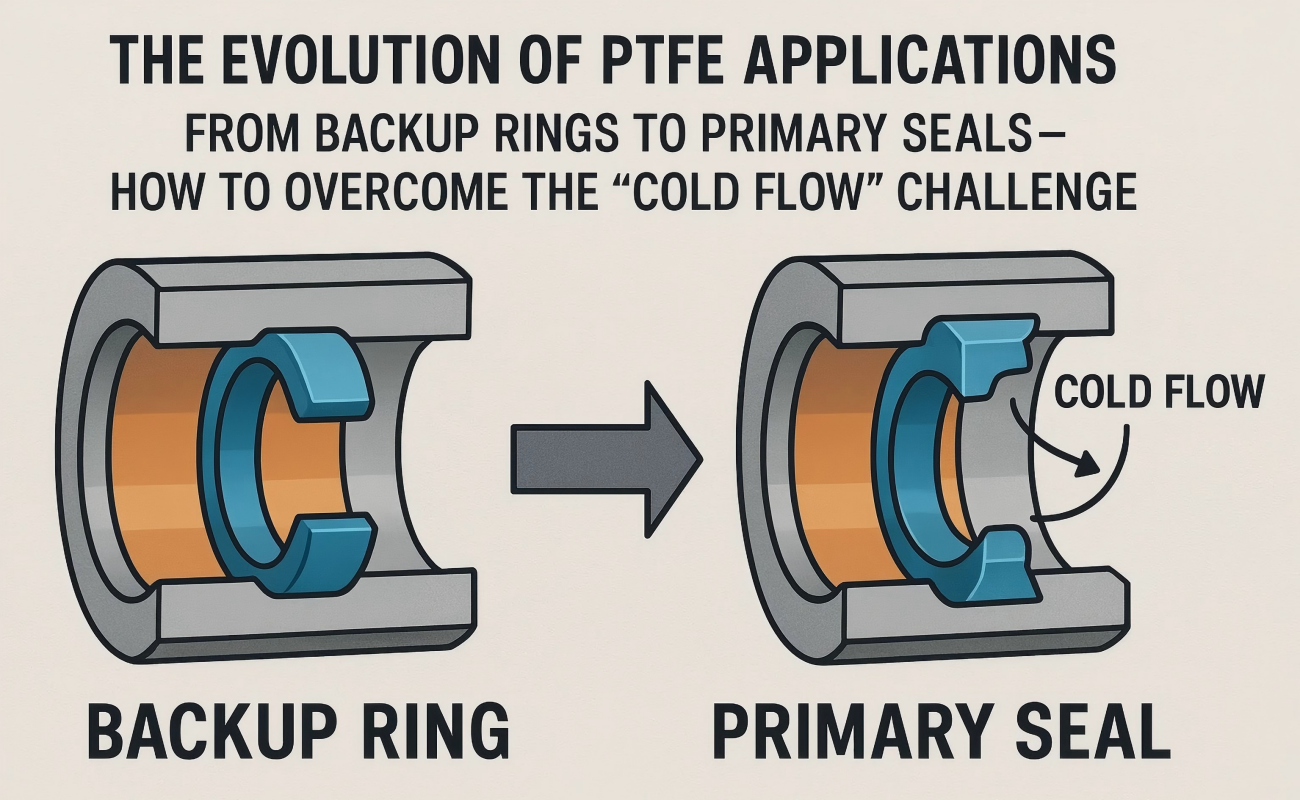
However, PTFE also has one undeniable weakness—under continuous high pressure and high temperature, it easily exhibits “cold flow”, a slow plastic deformation that leads to loss of sealing preload, lip deformation, and even extrusion failure.
This is why traditional PTFE was limited to backup rings, guide rings, and support rings rather than main sealing roles. But with continuous advancements in material modification technologies, PTFE is breaking past its historical limitations.
Today, in the main cylinders of excavators, bulldozers, loaders, and even hydraulic breakers, modified PTFE has evolved from a “supporting role” into a true pressure-bearing primary sealing material—enabled by breakthroughs in filler reinforcement technology.
Why Does PTFE Experience Cold Flow?
PTFE has a long-chain fluorocarbon molecular structure with relatively weak intermolecular bonding.
This naturally low cohesive strength makes PTFE prone to slow deformation under sustained pressure, causing creep or “cold flow.”
When this plastic flow accumulates, the seal’s geometry changes:
- Loss of initial preload
- Distorted sealing lips
- Broken lubrication film
- Gap extrusion
This is why pure PTFE struggles to maintain stability in hydraulic systems operating at 25–40 MPa.
Material Innovations
To solve the cold-flow challenge, the industry uses filler reinforcement to dramatically enhance PTFE’s resistance to deformation, wear, and thermal load.
Different fillers impart different mechanical strengths, allowing PTFE to perform reliably in harsher environments.
Below is a summary of common PTFE filler systems and their advantages in construction machinery:
| Filler Material | Performance Enhancements | Typical Applications |
|---|---|---|
| Glass Fiber | Improves structural stability and creep resistance while keeping low friction | Glyd rings & Step seals in excavator and bulldozer cylinders; high-speed reciprocation |
| Carbon Fiber | Enhances wear resistance, improves thermal conductivity, reduces friction heat | Hydraulic breakers, long-term high-temperature systems, marginal lubrication conditions |
| Bronze | Significantly boosts anti-extrusion and compressive strength, improves dimensional stability | Ultra-high pressure cylinders, static seals, high-load support positions |
With these enhancements, modified PTFE achieves 3–10 times higher resistance to cold flow than pure PTFE, enabling its use as a primary sealing material.
From Auxiliary Components to True Primary Seal Systems
In modern hydraulic cylinders, modified PTFE is no longer confined to backup components. It has become a major part of primary sealing systems, especially in Glyd rings and Step seals.
These seals use PTFE as the main sealing element, supported internally by an elastomer O-ring to provide initial preload.
This hybrid structure allows:
- PTFE’s low friction to reduce heat and energy loss
- The O-ring to compensate for low startup sealing force
- Stable performance under high pressure, long strokes, and high-speed reciprocation
- Reduced wear and minimized stick–slip behavior
For example, in excavator boom cylinders:
- Step seals maintain stability under high pressure and long-stroke movement
- Glyd rings offer excellent dimensional stability and consistent low friction
Meanwhile, PTFE backup rings and support rings work together with NBR, HNBR, and FKM seals to provide anti-extrusion capability at extreme pressures.
Material Selection Logic
Despite its excellent performance, PTFE is not a universal material.
For applications requiring high elasticity, impact resistance, or lower cost, such as:
- Dampers
- Low-pressure cylinders
- Short-stroke seals
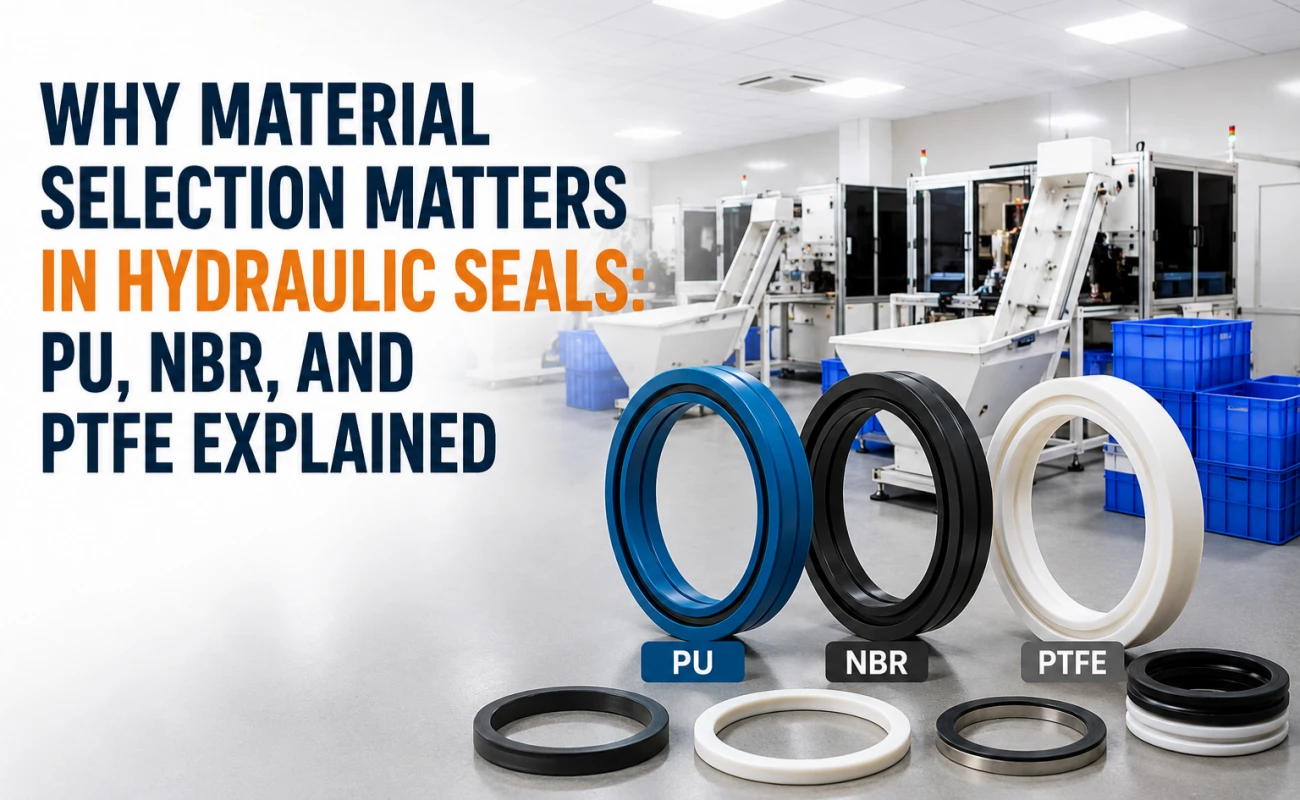
Materials like PU and NBR remain the dominant choices.
PTFE is best suited for applications involving:
- High pressure
- High speed
- High wear
- Low friction
- Harsh chemical or thermal environments
Thus, PTFE selection is performance-driven, not cost-driven.
KINTON SEALS Advantages
In the construction machinery sector served by KINTON SEALS, our PTFE sealing components benefit from:
- A wide range of filler formulas (glass fiber, carbon fiber, bronze, etc.)
- Strict formulation ratio control
- High-precision CNC machining optimized for heavy-duty hydraulic structures
- Fast response for small-batch, non-standard, and urgent orders
- Accurate compatibility across major brands:
Hitachi, Caterpillar, Doosan, Komatsu, and more
Whether the requirement is for glass-filled PTFE Glyd rings, carbon-filled guide rings, or bronze-filled high-pressure backup rings, we ensure high consistency, reliability, and performance across all hydraulic service environments.
Conclusion
PTFE’s evolution is enabling hydraulic systems to perform longer and more reliably.
From OEMs to hydraulic repair companies and large distributors, more users now recognize that material selection affects not just performance—but also system lifespan and operational risk.
With modified PTFE, these risks become far more manageable, enabling hydraulics to operate under extreme pressure, speed, and environmental demands.