
Product Applications

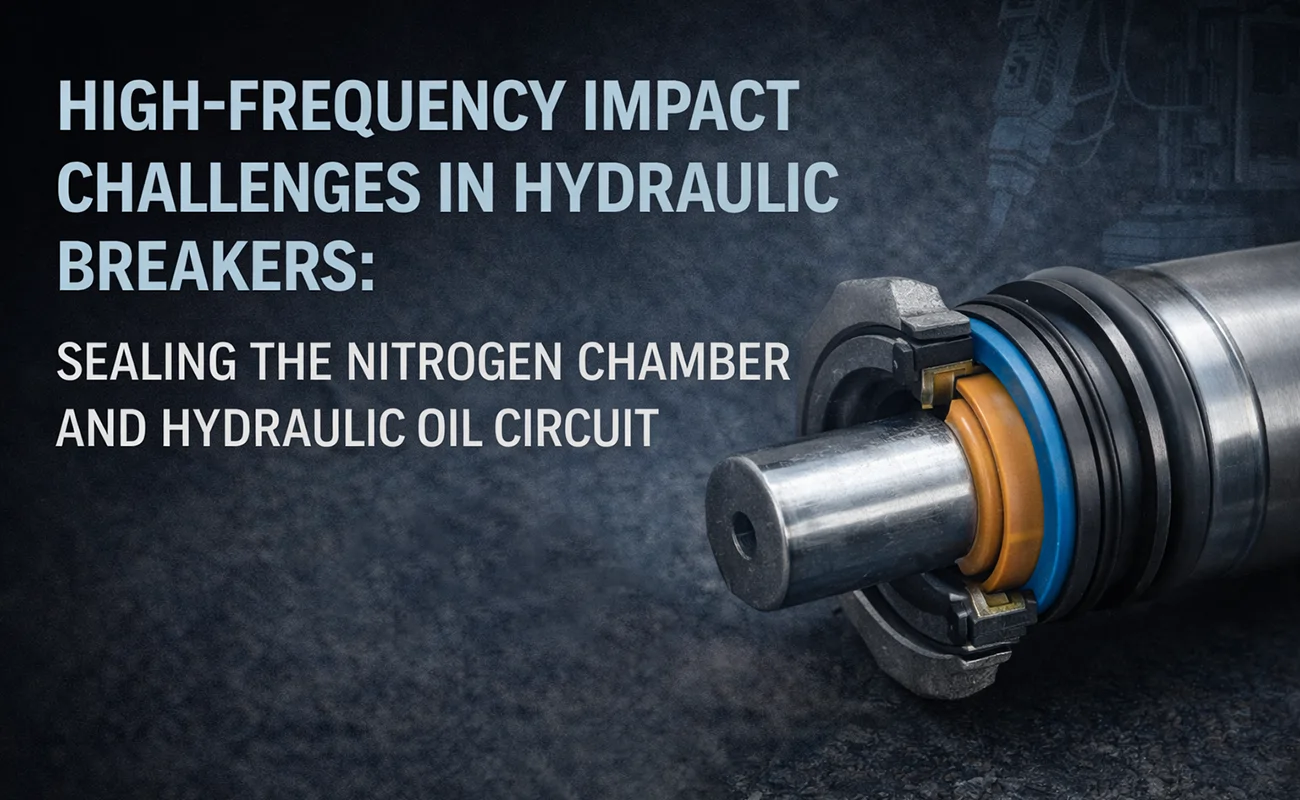
Impact Challenges in Hydraulic Breakers: Sealing the Nitrogen Chamber and Hydraulic Oil Circuit

Impact Challenges in Hydraulic Breakers

Among all hydraulic components used in construction machinery, the hydraulic breaker cylinder operates closest to extreme working conditions. Unlike excavator cylinders with relatively smooth reciprocating motion, or hydraulic pumps with continuous rotation, a hydraulic breaker works within a very short stroke while enduring high-frequency impact, extreme instantaneous pressure, and intense vibration.

Under such conditions, seals are no longer responsible solely for preventing oil leakage. Instead, they must simultaneously perform three critical functions: energy isolation, media separation, and dynamic stability.

The Real Sealing Challenges Under High-Frequency Impact

During operation, the breaker piston reciprocates at high speed under nitrogen gas energy storage. Each impact generates sharp pressure spikes and rapid temperature rise inside the cylinder.

Compared with conventional hydraulic cylinders, this impact load has two defining characteristics:

  • Extremely fast pressure fluctuations
  • Constant reversal of force direction

As a result, seals inside the groove are repeatedly subjected to compression, rebound, and shear forces, leading to highly concentrated stress.

The challenge becomes even more severe because hydraulic breakers contain both a hydraulic oil circuit and a high-pressure nitrogen chamber. Once the sealing system fails, nitrogen gas can migrate into the hydraulic oil.

This leads to:

  • Oil aeration and foaming
  • Unstable system pressure
  • Reduced impact frequency
  • Gradual loss of striking energy

This also explains a common field complaint:
The breaker feels weak, but there is no obvious oil leakage.

Why Nitrogen–Oil Isolation Matters More Than Leakage Prevention

In hydraulic breaker design, the primary objective of sealing is not absolute blockage of fluid movement, but precise control of media boundaries.

  • The nitrogen chamber must maintain stable pressure
  • The hydraulic oil circuit must sustain a continuous, controllable oil film

The accuracy of isolation between these two media directly determines the stability of impact energy output.

This places strict requirements on seal performance:
the seal must maintain controlled deformation under high-speed impact, without lip inversion, extrusion, or permanent compression set.

If elastic recovery is insufficient, gas gradually permeates the system.
If structural support is inadequate, seal edges may be destroyed during pressure spikes.

The Value of Step Seals in Hydraulic Breaker Cylinders

For non-standard operating conditions such as hydraulic breakers, traditional O-rings or simple lip seals often fail to deliver stable performance.

To address this, KINTON SEALS applies step seal structures (also known as step combination seals) specifically designed for high-frequency impact environments.

Step seals offer several key advantages:

  • Multiple sealing stages distribute instantaneous pressure across different contact areas
  • Reduced stress concentration on a single sealing edge
  • Improved resistance to extrusion under sudden pressure peaks

In addition, low-friction material formulations help control temperature rise during high-speed reciprocating motion, reducing thermal aging of the seal.

In practical use, this structure:

  • Lowers piston running resistance
  • Produces cleaner, more consistent impact action
  • Reduces energy loss caused by seal drag

Dedicated Gas Seals: The Invisible Key Component of Breaker Performance

If the main seal determines whether a breaker leaks oil, the gas seal determines whether the breaker delivers power.

The core task of a gas seal is not short-term sealing, but long-term prevention of high-pressure nitrogen migration into the hydraulic system.

KINTON SEALS’ dedicated gas seals for breakers emphasize:

  • Low gas permeability
  • Long-term elastic stability
  • Resistance to repeated impact and elevated temperature

Even under continuous high-load operation, these gas seals maintain stable sealing line pressure, preventing gradual nitrogen pressure loss.

For mining, demolition, and other continuous heavy-duty applications, the value of gas seals is reflected in:

  • Longer service intervals
  • More consistent striking performance
  • Reduced need for frequent nitrogen recharging

From “Consumable Seals” to Energy Management Components

In hydraulic breaker applications, sealing systems have evolved beyond passive consumables. They now play a direct role in energy conversion and output stability.

A minor sealing failure may not immediately cause visible leakage, but it can silently reduce impact efficiency and increase the load on the hydraulic system.

For this reason, KINTON SEALS focuses on structural compatibility, material stability, and long-term adaptability, rather than stacking isolated performance parameters.

By combining step seals with dedicated gas seals, reliable isolation between the nitrogen chamber and hydraulic oil circuit is achieved — ensuring that hydraulic breakers maintain consistent energy output even under extreme high-frequency impact conditions.